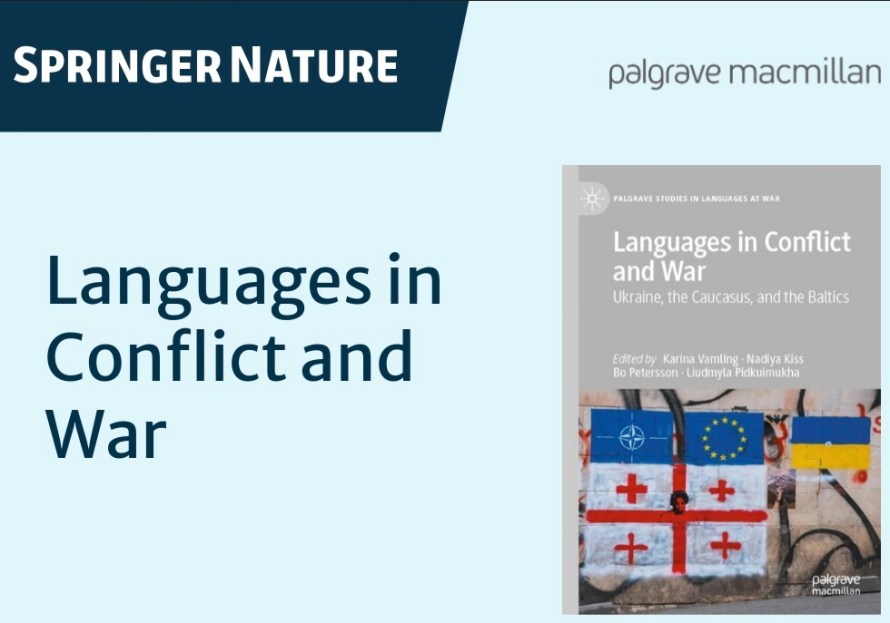
It’s a great pleasure to announce that a publication of which I am a co-editor and co-author “Languages in Conflict and War. Ukraine, the Caucasus, and the Baltics” has been published recently. It is a part of the book series “Palgrave Studies of Languages at War”. Many thanks to my colleagues in the editorial team Nadiya Kiss, Bo Petersson and Liudmyla Pidkuimukha.
More info on the publisher’s webpage: https://link.springer.com/book/10.1007/978-3-032-08419-4
Abstract from the Publisher’s webpage
This book explores language conflicts in Soviet successor states: Ukraine, the Russian North Caucasus, Georgia, and the Baltics. Current violent developments in these multiethnic countries with their shared legacies of Russian domination highlight the intertwining of language with conflict and war, reflecting confrontation and challenges to peace. It is shown how core values attached to language in identity formation and feelings of belonging or marginalization, along with attitudes to language use by the in-group in contrast to others, are easily subject to politicization. Forced migration, language erasure and shift, central in today’s post-Soviet conflicts, are also experienced by minorities in the Russian North Caucasus—such as the Circassians—based on their history of Russian colonization. The book will be of interest to readers in a wide range of fields, including sociolinguistics, language policy, and language contact, as well as identity politics, migration linguistics, state and nation building, area studies, post-Soviet and European studies, political science, international relations, and peace and conflict studies.
Table of contents and contributors:
https://link.springer.com/book/10.1007/978-3-032-08419-4#toc
1 Introduction: Languages in Conflict and War. Karina Vamling, Nadiya Kiss, Bo Petersson, Liudmyla Pidkuimukha
2 Language and Identity Erasure: Russia’s Strategy in the Occupied Regions of Ukraine. Liudmyla Pidkuimukha
3 Language Shift, Displacement, and Abrogation: Narratives of the Ukrainian Writers in Times of War. Nadiya Kiss
4 Depopulation of the Hungarian National Minority in Transcarpathia as One of the Consequences of Russia’s War against Ukraine. Halyna Shumytska and Fedir Shandor
5 The Sororization Effect in Interviews with Refugees: Negotiation of Positionality, Shared Knowledge, and Emotions. Lesya Skintey and Dariia Orobchuk
6 Linguistic Sovereignty and Vernacular Biopolitics: Estonian Russophones as a Postcolonial Phenomenon. Andrey Makarychev
7 Between Hopes and Anxiety: A Critical Analysis of Discourses Surrounding Latvian Russian-Speaking Youth during the Russo-Ukrainian War. Lena Hercberga
8 Surviving Suppression: Circassian Language Preservation in Russia and the Diaspora. Lidia Zhigunova
9 “It all starts in the family”: Placing Discourses on the Role of Families in Circassian Language Preservation into a Historical-Political Context. Valeriya Minakova
10 The Future of the Indigenous Circassian Language amid Increased Russification of the Kuban Region and the Russian War in Ukraine. Lars Funch Hansen
11 Official Language Ecology in Contemporary Georgia. Mariam Manjgaladze
12 Functions of the Russian Language in Modern Georgia. Tinatin Bolkvadze
13 The Linguistic Landscape of Georgia—Diachronic and Synchronic Approaches. Maka Tetradze
14 Conclusions. Karina Vamling, Nadiya Kiss, Bo Petersson, Liudmyla Pidkuimukha
Categories:Publications

 Karina Vamling
You must be logged in to post a comment.